
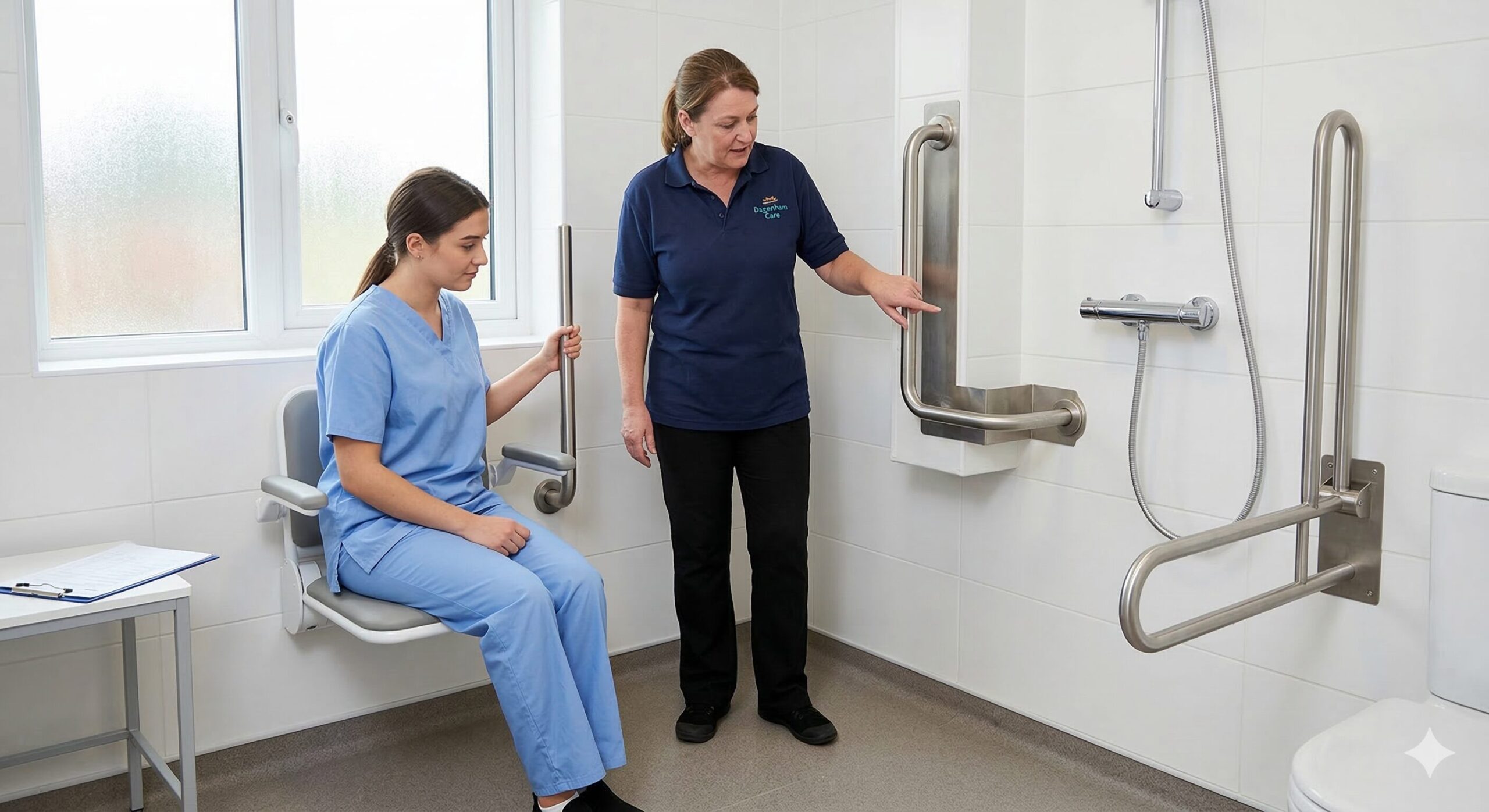
Correctly specified support rails and shower seating are essential for creating safer bathrooms that support resident stability and allow staff to assist comfortably.
Bathrooms in care homes must accommodate residents with a wide range of mobility needs. Many residents rely on physical support while standing, transferring, or bathing. Support rails and shower seating therefore play a central role in helping residents maintain stability while also making assisted care safer and more manageable for staff.
However, the effectiveness of these features depends on proper specification and positioning. Poorly chosen or incorrectly placed fittings can make movement awkward and reduce the confidence of both residents and carers. Care-home managers should therefore consider how these fixtures will perform in real daily use rather than viewing them simply as compliance features.
The key principle:
Support rails and seating should be positioned around real movement and transfers within the bathroom, not simply installed to meet minimum design expectations.
Why support rails and shower seating matter
Bathrooms combine wet surfaces, reduced mobility, and assisted care routines. Even small movements—such as stepping into a shower area or rising from a seat—can become difficult without appropriate support points. Rails and shower seating help residents maintain balance while also reducing strain for staff assisting with personal care.
When integrated thoughtfully into the bathroom layout, these fixtures improve safety, confidence, and dignity. They also contribute to smoother care routines by allowing carers to assist residents in stable, comfortable positions.
Key considerations when specifying support rails
1. Correct positioning
Rails should be located where residents naturally reach for support during movement or transfers. Positioning should reflect the flow of movement within the room rather than simply following standard layouts.
2. Secure structural fixing
Support rails must be installed into reinforced walls or structural supports so they can safely carry body weight during transfers and balance support.
3. Comfortable grip and diameter
Rails should be easy to hold securely, even with wet hands. Appropriate diameter, spacing from the wall, and a non-slip finish improve usability.
4. Durable materials
Materials should resist corrosion, withstand frequent cleaning, and maintain structural integrity under constant use in a wet environment.
What to consider when specifying shower seating
1. Stability and load capacity
Shower seating must be strong enough to support residents safely during bathing and transfers.
2. Appropriate height and positioning
Seating height should support comfortable transfers and allow carers to assist safely without awkward movement.
3. Space efficiency
Fold-down seats are commonly used in wet rooms because they provide support when needed while allowing additional space for assisted movement when folded away.
4. Hygiene and cleanability
Surfaces should be smooth and easy to clean, allowing staff to maintain hygiene standards without difficulty.
Designing around real movement
The most effective bathroom environments are designed around how residents actually move through the space. Support rails and seating should align with transfer points, turning areas, and shower access routes. When fixtures match real movement patterns, residents feel more confident and staff can assist more comfortably.
This is why these fittings should always be considered as part of the overall bathroom design rather than being added after the layout has already been determined.
Quick specification checklist
- Are rails positioned where residents naturally reach for support?
- Are fixtures securely fixed into reinforced walls?
- Is seating comfortable and stable for bathing?
- Does the layout allow carers to assist without restriction?
- Are materials durable and easy to clean?
- Do the fixtures support both independence and assisted care?
Frequently asked questions
Why are support rails important in care bathrooms?
What type of shower seating works best?
Should rails and seating be added after the bathroom is designed?
Why work with a specialist contractor?
Planning safer bathroom fittings for your care environment?
Care Design Bathrooms provides specialist bathroom solutions designed for safety, accessibility, and reliable long-term performance in care environments.
Contact Us